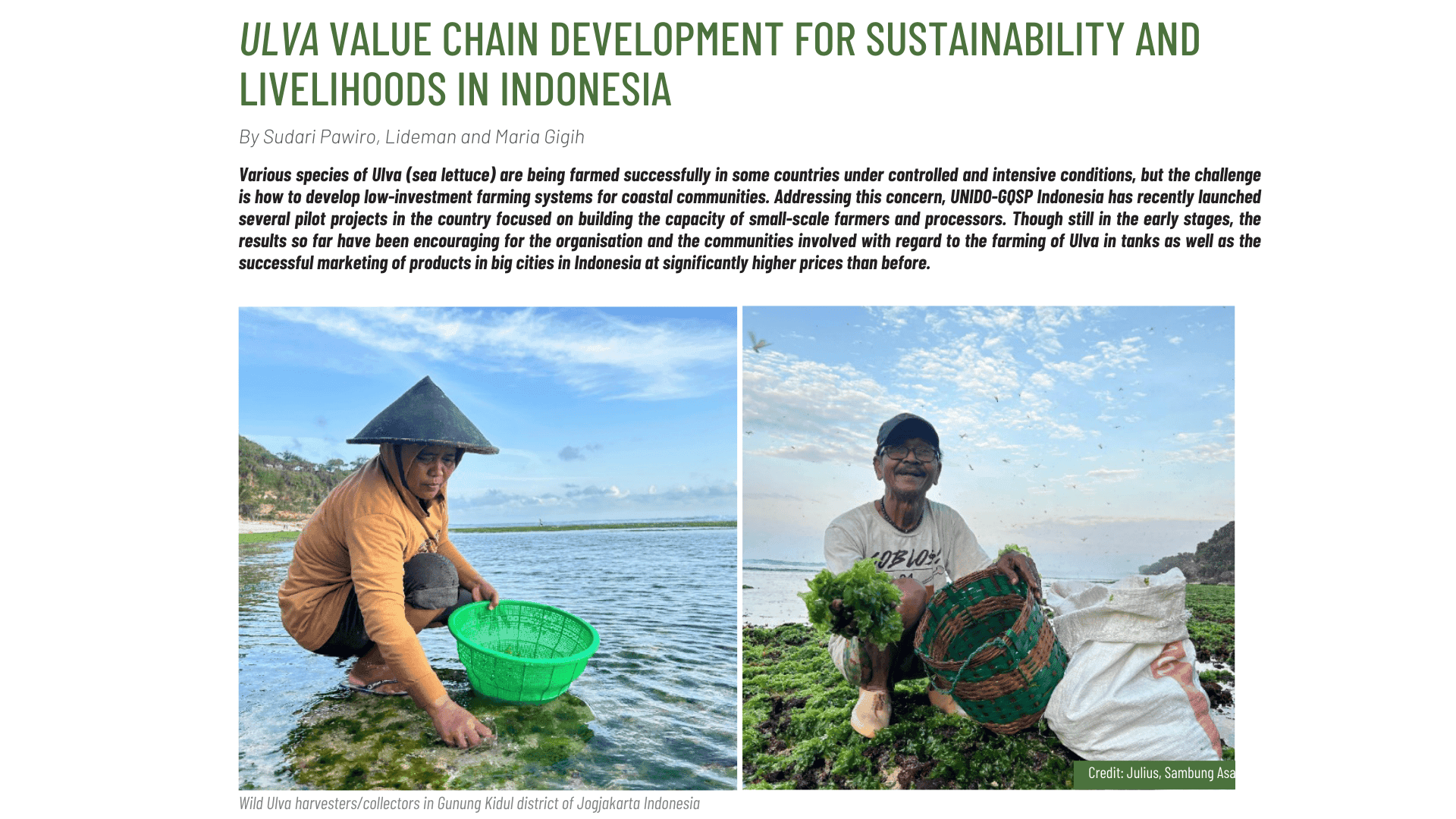
INFOFISH International (01/2025) - Various species of Ulva (sea lettuce) are being farmed successfully in some countries under controlled and intensive conditions, but the challenge is how to develop low-investment farming systems for coastal communities. Addressing this concern, UNIDO-GQSP Indonesia has recently launched several pilot projects in the country focused on building the capacity of small-scale farmers and processors. Though still in the early stages, the results so far have been encouraging for the organisation and the communities involved with regard to the farming of Ulva in tanks as well as the successful marketing of products in big cities in Indonesia at significantly higher prices than before.
Indonesia is well known as the world’s largest producer of tropical red seaweed species, mainly Kappaphycus alvarezii (Eucheuma cottonii), E. spinosum and Gracilaria spp., comprising around 45% of the global red seaweed production in 2022. These species are mainly utilised for carrageenan and agar production. At the same time, the country is also seeing significant growth in the edible green seaweed sector, involving species such as sea grape (Caulerpa spp.) and sea lettuce (Ulva spp.). Sea grape is very popular in some parts of Indonesia, particularly in South Sulawesi and the northern coastal areas of Central Java; it is eaten fresh as a salad vegetable and is available from wild harvests as well as farmed. Sea lettuce is also abundantly available in Indonesia, being harvested from the wild in the coastal areas of Sulawesi, Lombok and the southern coastal areas of the island of Java. The main species harvested is U. lactuca, and to a lesser quantity, U. reticulata, U. linza and U. compressa. Traditionally, harvesters collect Ulva along the coastal areas during low tide, sell it in dried form to local traders who then send it to processors/ traders/exporters supplying local and export markets for food, feed, fertilizer and pharmaceutical purposes.
To read the full article please visit :
INFOFISH International Issues 1/2025